
Skip to product information


PDF eBook
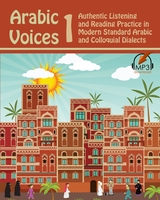
Arabic Voices 1
11 reviews
$20
A listening and reading practice book designed to improve comprehension of authentic Arabic across Modern Standard Arabic and major colloquial dialects.
This is a PDF eBook, delivered as a digital download.
Looking for a physical copy? See where to buy the paperback.
| Level | B1 • B2 |
|---|---|
| Length | 187 pages |
| Series | Voices |
| Format | PDF eBook |
Click to Play Intro Video
 Key Features
 Key Features
Arabic Voices 1 is an eBook that helps you build real listening and reading skills through authentic Arabic as it is actually spoken.
Instead of scripted dialogues, this eBook uses natural, unscripted recordings that reflect real speech, including hesitations, rephrasing, and regional variation. You are guided through a structured listening process that emphasizes repeated exposure before reading, helping you develop effective comprehension strategies. Along the way, you encounter Modern Standard Arabic alongside major spoken dialects, gaining practical insight into how diglossia works in everyday communication.
What’s inside
- 28 authentic listening segments across multiple Arabic varieties.
- Modern Standard Arabic and colloquial dialect recordings.
- Arabic transcripts with minimalist voweling.
- Side-by-side English translations.
- Structured comprehension exercises, including Main Idea, True or False, Multiple Choice, and Matching.
- Dialect-to-MSA matching activities.
- Linguistic and cultural notes.
- Focus sections on grammar and usage.
- Speaker data boxes with speech rate and word count.
Who it’s for: Intermediate and advanced learners of Arabic with a basic foundation who want to understand real spoken Arabic across regions.
Audio: Audio for all segments is available to download or stream below.
Use Arabic Voices 1 to train your ear and develop confidence with authentic Arabic.
 Detailed Overview
 Detailed Overview
Many intermediate students find that even after years of study, they feel lost when listening to a native speaker in a natural setting. The problem is that most textbooks rely on “sanitized” Arabic, scripted, unnaturally slow, and grammatically perfect. Arabic Voices 1 is designed to break that pattern by introducing you to the “beautiful mess” of authentic, unscripted speech, bridging the gap between classroom theory and the reality of how Arabs actually communicate.
A Foundation of Authenticity
This book features twelve participants from across the Arab world, including Syria, Iraq, Morocco, Egypt, Jordan, Yemen, Tunisia, and Lebanon. The journey begins with personal introductions from each speaker. Some choose to introduce themselves in Modern Standard Arabic (MSA), while others use their native dialects. Because these recordings are unscripted, you will encounter natural fillers, hesitations, and the “mistakes” that even native speakers make, preparing your ear for the rhythm of real-world Arabic.
Structured Methodology for Success
To maximize your progress, the book outlines a rigorous step-by-step guideline in its “How to Use This Book” section. You are encouraged to lead with your ears, listening to segments multiple times before looking at the text. The process begins by orienting yourself with the Title and Key Words to establish context. You then move through a series of exercises, Main Idea, True or False, and Multiple Choice, designed to uncover details gradually. Vocabulary is reinforced through Matching exercises, followed by a deep dive into the Text and Translation, which is broken into manageable, numbered lines. The session concludes with a Grammar Focus and a final listen to consolidate the material.
Topics Covered in Book 1
- Personal Life: Personal Introductions, Childhood Memories, and University Life.
- Society and Culture: Marriage (Morocco and Egypt), Clothing, Dating, and Religion.
- Modern Interests: Transportation, The Royal Family (Jordan), Health, Qat (Yemen), Computers, and Revolution.
Free Supplementary Video Lessons
To further support your journey, we offer free supplementary video lessons featuring teacher Mostafa Ahmed. In these videos, he takes you through every MSA segment, pointing out interesting grammatical and lexical points, as well as the natural mistakes speakers make. The videos include Arabic and English subtitles, and the transcripts appear right under the video for you to follow along with or print out for your study sessions. You can access these resources at: https://resources.lingualism.com/tag/arabic-voices/.
A Trusted Resource
This methodology is so effective that it has been adopted into university syllabi and is used by government agencies. It has also been professionally reviewed in Al-ʿArabiyya: Journal of the American Association of Teachers of Arabic. While this volume covers a broad range of dialects, we also offer specialized books using this same methodology specifically for Egyptian, Lebanese, Syrian, and Palestinian Arabic.
 PDF Sample
 PDF Sample
Take a closer look inside!
Not sure if this book is right for you? Download a free sample for an extended preview and try out the materials before you decide to buy. See how the PDF eBook looks on your screen and how it prints out.
 Audio Stream
 Audio Stream
 Audio Download
 Audio Download
MP3 Files
Download the full accompanying audio for this product as MP3 files—completely free! The files are provided in a compressed ZIP folder for easy access. Simply download, extract the files, and start listening. No purchase of the PDF eBook is required!
 Paperback?
 Paperback?
This book is also available in paperback!
On Lingualism.com, this book is sold as a PDF eBook only.
A paperback edition is also available via IngramSpark* for US and UK addresses, and through Amazon worldwide. You may also ask your local bookstore or library to special order a copy.
Please note that paperback editions are printed with black-and-white interiors, which differ from the full-color sample images shown for the PDF eBook above.
* If the IngramSpark link is not appearing below, please check back soon. We're currently adding them in.


 Customer Reviews
 Customer Reviews
S
Steven Very honored that the Lingualism team recorded the voice of Wasem
(A Palestinian Arab citizen of the Green
Triangle,Israel) very rare to have someone who is Palestinian by nationality but Israeli by citizenship there's more people like him that you guys should do more recordings on that alive all around Israel,Palestine and abroad that would like their voices heard and recorded
D
David This is an absolutely fabulous book with which to learn Arabic! This one as well as its sequel is a true gem in language-learning country. In my opinion, there are two things that make this book especially valuable: 1) the focus on natural, spontaneous speech instead of the rigid, inflexible and read-out stuff that FuSHa-learners usually have to work with 2) The meticulously produced and highly accurate transcriptions of what is sometimes fuzzy, incoherent and non-standard speech, as well as the many interesting footnotes and remarks. From a linguistics-perspective, this is the very best way to master spoken language. Anyone learning Arabic in my opinion should use this book. I would obviously recommend it to anyone interested in Arabic.
n
nohaothman Wonderful channel
R
Richard If you want to develop your Arabic at an intermediate level with a focus on understanding native speakers, then you have found home. The authors do not skimp: 28 episodes with audio recording of the highest quality, text transcription, questions that check language comprehension. Excellent for self-studies. The reasonably long (short) sections enable you to complete an entire section without a break even if you are busy. If you have English as your first language or use English daily (not me) do as the author recommends in the preface. If you get tired of keeping track of two languages at the same time, do as I do: listen the audio a few times then read the Arabic text then watch the free video lesson on the website. There is a short lesson for each episode in MSA with an exceptionally fine pronunciation and pedagogical explanation, this is very impressive. When I have some energy and time left, I take the English control questions last. I highly recommend this material. I also bought the Arabic Voices No2 of course!
b
bopp23 This is a great way to hear the different dialects
 You may also be interested in...