
Skip to product information


PDF eBook
Arabic vs. Arabic: A Dialect Sampler
7 reviews
$16
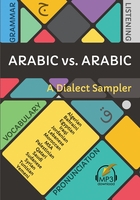
Arabic vs. Arabic is an eBook that compares Modern Standard Arabic with Moroccan, Egyptian, Levantine, Gulf, Yemeni, and other regional dialects through clear side-by-side examples.
This is a PDF eBook, delivered as a digital download.
Looking for a physical copy? See where to buy the paperback.
| Level | A1 • A2 |
|---|---|
| Length | 196 pages |
| Format | PDF eBook |
Click to Play Intro Video
 Key Features
 Key Features
Arabic vs. Arabic is an eBook that lets you explore how Modern Standard Arabic compares with spoken dialects from across the Arab world.
This eBook covers Modern Standard Arabic alongside Moroccan, Algerian, Tunisian, Sudanese, Egyptian, Palestinian, Jordanian, Lebanese, Syrian, Iraqi, Qatari, Bahraini, Saudi (Hejazi), and Yemeni Arabic. Instead of focusing on memorization, it encourages browsing and comparison through clear side-by-side tables. You can see how vocabulary, pronunciation, and grammar vary by region while also identifying shared patterns and areas of mutual intelligibility. Native-speaker audio connects written comparisons with real pronunciation.
What’s inside
- Side-by-side comparison tables for 15 varieties of Arabic.
- Modern Standard Arabic plus 14 regional colloquial dialects.
- Vocabulary themes such as food, technology, animals, and daily life.
- Social expressions and courtesies across regions.
- Comparative grammar sections including pronouns, verb forms, and negation.
- Linguistic and cultural notes explaining regional differences.
- Native-speaker survey insights on dialect difficulty and perception.
- A “Your Notes” section for personal observations.
Who it’s for: Learners of all levels studying Modern Standard Arabic, a spoken dialect, or both, who want a broader understanding of Arabic variation.
Audio: Audio from native speakers of each dialect is available to download or stream below.
Use Arabic vs. Arabic as a sampler, reference, or companion alongside any Arabic study path.
 Detailed Overview
 Detailed Overview
Demystifying the Arabic Continuum
If you’ve ever felt paralyzed by the choice between Modern Standard Arabic (MSA) and various dialects, you aren’t alone. Many students worry that if they pick one, they are missing out on the “real” language, or they feel overwhelmed by the idea that there are dozens of “different” languages to learn. This book is designed to solve that confusion. The goal isn't to help you choose a favorite region. Rather, it’s to give you a comprehensive feel for how the language actually functions as a living continuum.
By studying all 15 varieties side-by-side, including 14 spoken dialects and MSA, you begin to see that Arabic is neither a single monolith nor a collection of disconnected languages. It is a beautiful spectrum.
Seeing the Big Picture Through Comparison
The most efficient way to understand this variety is through direct, side-by-side comparison. This book guides you through specific categories so you can spot the patterns yourself. You’ll explore sections dedicated to single words like common nouns, adjectives, and numbers, where you can see how “cat” or “shoes” change as you move across the map.
You will also dive into the structural heart of the language through pronouns and verb conjugations. Seeing how a verb like “to write” is conjugated in the past and present across 15 different varieties helps you realize that while the prefixes and suffixes might shift slightly, the core logic remains remarkably consistent. The book then moves into full sentences, allowing you to observe how vocabulary, grammar, and pronunciation all come together in real-world contexts, such as describing a situation or asking a question.
A Peek Into the Culture
One of the most valuable parts of this book is the “Arabs Say...” section at the back. These are real survey responses from native speakers that provide a “behind-the-scenes” look at the language. For example, you’ll read about a Tunisian speaker who shares a funny, embarrassing story of how the Egyptian word for “look” (buss) actually means “fart” in Tunisia.
Another fascinating insight comes from a Jordanian speaker who explains that while the letter qaf has different regional sounds, there is a modern social trend where men often use a “g” sound to sound more masculine, while women use a glottal stop to sound more feminine. These insights help you understand the social life of the language in a way that a standard dictionary never could.
How to Use This Sampler
I encourage you to use this book as an exploratory tool in your daily study sessions. Don't approach it with the intent to memorize lists. Instead, listen to the 15 native speakers on the accompanying audio tracks and mark up the tables. Highlight the words that surprise you and circle the universals.
By the time you’ve worked through these comparisons, you will have demystified the Arabic-speaking world. You’ll realistically achieve a “linguistic intuition,” the ability to recognize where a speaker is from and, more importantly, the confidence to navigate the similarities and differences that make Arabic so unique. You’ll stop seeing “different languages” and start seeing one incredibly rich, flowing spectrum.
 PDF Sample
 PDF Sample
Take a closer look inside!
Not sure if this book is right for you? Download a free sample for an extended preview and try out the materials before you decide to buy. See how the PDF eBook looks on your screen and how it prints out.
 Audio Stream
 Audio Stream
 Audio Download
 Audio Download
MP3 Files
Download the full accompanying audio for this product as MP3 files—completely free! The files are provided in a compressed ZIP folder for easy access. Simply download, extract the files, and start listening. No purchase of the PDF eBook is required!
 Paperback?
 Paperback?
This book is also available in paperback!
On Lingualism.com, this book is sold as a PDF eBook only.
A paperback edition is also available via IngramSpark* for US and UK addresses, and through Amazon worldwide. You may also ask your local bookstore or library to special order a copy.
Please note that paperback editions are printed with black-and-white interiors, which differ from the full-color sample images shown for the PDF eBook above.
* If the IngramSpark link is not appearing below, please check back soon. We're currently adding them in.


 Customer Reviews
 Customer Reviews
F
Fabio The book is perfect, the author had a really great idea to write something like this. The book is totally worth 5 stars, but I only gave 4 because it doesn’t include the Kuwaiti dialect, which happens to be the one I’m more interested in, unfortunately. All in all, it’s a good purchase nonetheless.
R
Rima Wow, this is incredible work. The thought that went into make this type of resource is truly a work of art. Some of the dialects covered in these books barely have any resources online. I'm so impressed with the range of dialects covered in this book. And the fact that there's accompanying audio so that you can actually hear the native speakers... This type of resource is so difficult to find, this package is so underrated. I would give it 10 stars if I could. Even for native Arabic speakers, there isn't a single source where you can get access to all dialects in one organized compilation like this. I wish there was a whole dictionary like this!
D
Danielle This is a great book to introduce yourself to the dialects, it lets you compare between the dialects and MSA in the easy to follow tables used. The range of information is limited so if you are wanting to fully develop your knowledge on one particular dialect then you would need further resources, but as an introductory tool I can't fault this book too much. Would definitely recommend to anyone trying to get an insight into any of the dialects included in the book.
F
Fan Good for get to know something about various Arabic dialects. But the scope is limited.
S
Sercan This book is truly amazing. I can recommend it to anyone. Even if you're learning a dialect where are many other resources available, like Egyptian Arabic, you should still consider to get this book anyway. This way you'll be able to compare the dialect you're learning to other dialects and MSA. The accompanying Anki Flashcard Decks are amazing as well. The book covers a basic knowledge of grammar and vocabulary, even for Arabic dialects which barely got resources online. So if you're looking forward to learn an uncommon dialect, like for example Yemeni Arabic or Bahraini Arabic, then you should definitely get this book.
 You may also be interested in...