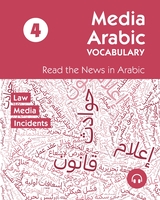
As you reach the final installment of this series, the focus shifts to a different set of high-impact domains within public discourse. While you may already feel comfortable with everyday conversation, the professional language of legal proceedings, journalistic practice, and emergency reporting often feels like a distinct register of Arabic. Media Arabic Vocabulary (Book 4) is designed to address that gap directly, helping you move beyond the “intermediate plateau” and develop practical media literacy across these specialized areas.
In this volume, we explore three pillars of modern society, each broken down into specialized subtopics:
- Law and Justice: Criminal Justice and Law Enforcement (Police Procedures, Investigations); Trial Procedures and Sentencing (Courtroom Dynamics, Prisons); Civil and Criminal Law; International Law and Human Rights; Contracts and Business Law; Intellectual Property (Patents, Copyrights, Digital Rights).
- Media and Journalism: Types of Media (Print, Broadcast, Online and Social Media); Reporting and Writing (Ethics, Story Structure); Opinion Writing and Editorials; Investigative Journalism; Feature Writing.
- Accidents and Incidents: Transportation Accidents (Road, Aviation, Maritime); Industrial and Workplace Incidents (Manufacturing, Mining); Public Venue Incidents; Medical Emergencies (Trauma, Acute Conditions).
A Graduated Path to Literacy
The strength of this book lies in its “controlled text” approach. Rather than expecting immediate engagement with dense legal briefs or investigative reports, each section begins with “mini-articles,” short, high-impact texts that provide immediate wins and reinforce core vocabulary.
Once confidence builds, the material expands into diverse, native-style texts drawn from real reporting contexts. You will study historical accounts of the trial of Hosni Mubarak and the role of social media in the Egyptian Revolution, analyze investigative essays on so-called fake news, and read factual reports on events such as the disappearance of Flight 370 or the Hajj stampede. This range ensures exposure to how language adapts across genres, from the precision of legal writing to the narrative flow of long-form journalism.
The Self-Discovery Method
Traditional “busy work” such as multiple-choice drills has been intentionally excluded. In a real study session, you take on the role of investigator. The task is to use the vocabulary lists to observe how words interact within authentic texts.
Through this process, you begin to notice how legal terminology forms predictable collocations and how journalistic tone shifts between editorials, reports, and features. This kind of active engagement is essential for developing the intuition required for independent reading.
Built-In Support and Realistic Results
To keep momentum high, the book provides a strong safety net. Every Arabic text includes a full English translation, allowing you to check comprehension instantly without relying on a separate dictionary. In addition, all Arabic content features full diacritics (tashkeel) and accompanying audio tracks, supporting accurate pronunciation and listening comprehension.
By the time you finish this book, you are not simply expanding vocabulary. You are gaining the specialized toolkit needed to follow courtroom verdicts, evaluate news coverage, and understand emergency reporting in real time. This is the shift from studying Arabic to using it as a lens on the world.